Floral Camera
A Quirky, Charming Design That Feels Like a Hand-Drawn Sketch
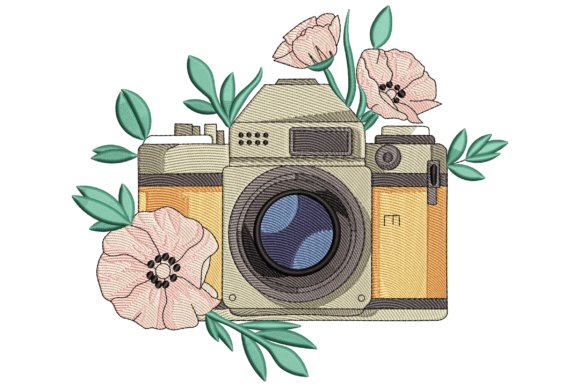
First glance at Floral Camera tells you everything you need to know: it’s playful without being childish, detailed without feeling fussy, and botanical without leaning into cliché. The camera body is clean-lined and slightly retro—think mid-century film camera—but softened with delicate vines, tiny blossoms, and looping stems that wrap around the lens like living embroidery. It doesn’t scream “tech” or “photography”—it whispers “memory,” “craft,” and “intentional joy.” That’s rare. Most camera-themed embroidery leans hard into gadgetry or nostalgia; Floral Camera sidesteps both and lands somewhere warmer—like a hand-stitched journal cover or a gift for someone who collects pressed flowers *and* vintage lenses.
Where It Shines: Real Projects, Real Reactions
Last week, I stitched Floral Camera onto a natural linen tote bag for a local boutique’s spring launch. No applique—just direct machine embroidery using 40-weight cotton thread and medium tear-away stabilizer. The result? Instant conversation starter. Customers didn’t just say “cute”—they paused, tilted their heads, and asked, “Is that a real camera?” Then they smiled when they saw the petals curling off the viewfinder. That’s the quiet magic of this design: it invites attention *without* demanding it.
It works especially well on relaxed, breathable fabrics where stitch texture reads clearly—think organic cotton tees, waffle-weave tea towels, or unbleached canvas aprons. On a baby onesie (tested with lightweight cutaway stabilizer), the floral elements read as soft and gentle—not too busy, not too sparse. And for Etsy sellers building cohesive collections, Floral Camera fits seamlessly alongside botanical motifs, minimalist line art, or vintage-inspired typography—it’s versatile enough to anchor a theme but distinctive enough to stand alone.
Where to Pause—and Why
This isn’t a one-size-fits-all embroidery file. Its charm lives in its balance: fine lines meet open negative space, and small flower centers rely on crisp satin stitch definition. That means it needs thoughtful execution, especially on challenging substrates:
- Stretchy fabric? Use cutaway stabilizer *and* a light tear-away topper—those thin stems can pucker or distort if the base shifts.
- Dark fabric? Test thread contrast first. Light pastel greens or ivory threads pop beautifully, but pale yellows vanish on navy or charcoal unless you add a subtle underlay.
- Curved surfaces like caps or curved pillow covers? Avoid placing the lens center directly over high curves—it risks distortion. Rotate the design slightly or scale down 5–7% for better conformity.
- Thin or sheer fabric? Watch the stitch density in the floral clusters—they’re dense enough to hold shape but may show backing through gauzy materials. A lightweight fusible stabilizer underneath helps.
Also: don’t force it into ultra-small hoops. While it scales down decently, the smallest blossom centers start losing clarity below ~3.5 inches wide. For patches or keychain charms, consider simplifying by hand or choosing a vector-editable version—if your source provides one.
What It Adds to Your Finished Product—Beyond Pretty
Using Floral Camera isn’t just about decoration—it subtly elevates perception. On custom apparel, it signals thoughtfulness: this isn’t mass-printed; it’s stitched with care. On personalized gifts—say, a bridal shower towel set or a new-parent onesie bundle—it adds warmth and narrative. Buyers don’t just see a camera; they imagine moments captured, memories tended, creativity honored.
For craft businesses and Etsy sellers, it strengthens brand consistency when paired with complementary design assets—like coordinating monograms or border motifs. And because it straddles “artistic” and “accessible,” it appeals across age groups: teens love the irony, grandparents appreciate the whimsy, and designers respect its balanced composition.
Practical Designer Notes Before You Stitch
- Always test on scrap fabric first—especially if you’re using textured weaves or blending thread colors.
- Check stitch density visually before running full production. Dense fill areas should lie flat, not mound or shadow.
- Review small details in black-and-white mockups. If the lens rim or petal outlines disappear in grayscale, adjust thread contrast or stitch width.
- Compare light vs. dark background renders—not just for color choice, but for how legibility shifts across your product line.
- Confirm stabilizer pairing: medium cutaway for knits, tear-away for stable wovens, fusible + tear-away for sheers.
- Verify licensing terms before selling finished products or bundling Floral Camera into digital embroidery kits—commercial use rights aren’t automatic with every embroidery file.
- Use it as a design anchor, not filler. Let its personality guide your product naming (“Botanical Snapshot Towel”), packaging tone, or social media captions.
Final Thought: Not Just Another Embroidery File
Floral Camera earns its place in my go-to folder—not because it’s flashy, but because it’s reliable, expressive, and quietly memorable. It’s the kind of machine embroidery design that makes customers pause mid-scroll, makes clients ask, “Where did you find *that*?”, and makes handmade product listings feel intentional rather than decorative. Whether you’re stitching for a holiday embroidery collection, building a small shop product line, or creating a personalized gift with emotional weight, Floral Camera delivers more than visual appeal—it delivers resonance. Just remember: let the fabric, stabilizer, and thread choices do their part. This design doesn’t need rescue—it just needs respect for its quiet, floral-hearted precision.